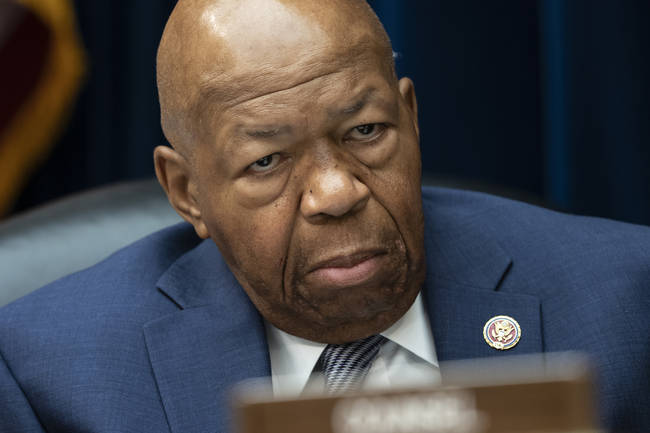
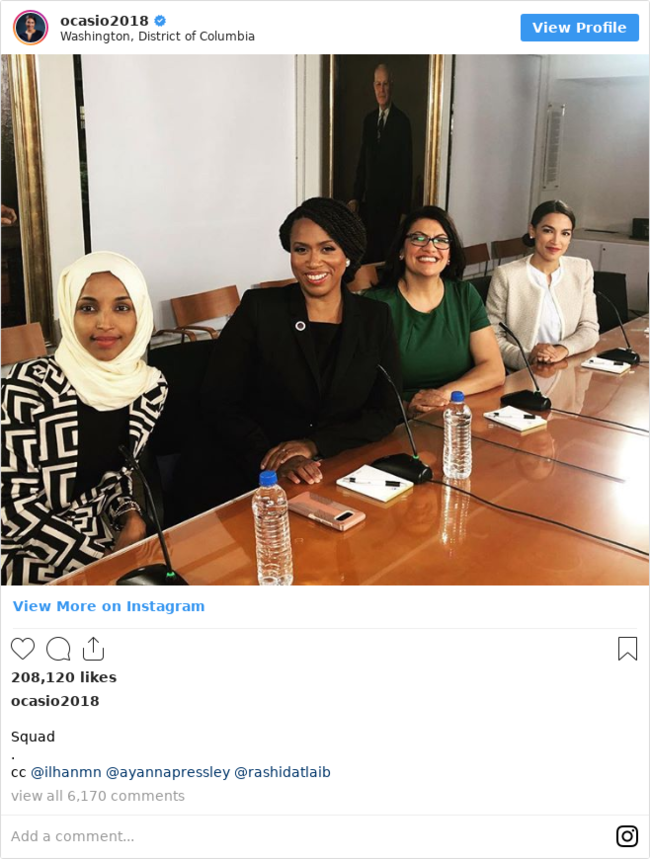
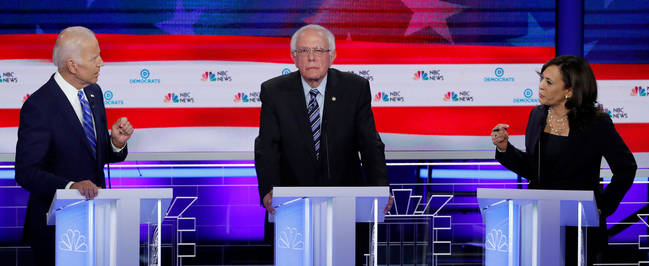
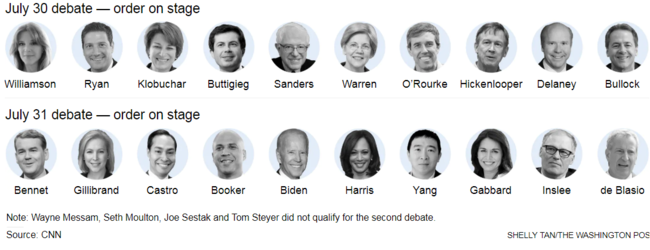
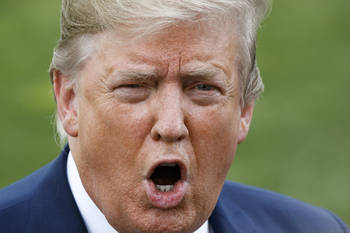
| When President Trump tweeted that four minority congresswomen should "go back," it seemed as if he jumped into a massive race-and-politics controversy without much foresight. But two weeks later, Trump is again tweeting racially insensitive things about Democrats, and this time it seems much more calculated. In fact, igniting racial debates is now part of his reelection strategy — but he lights those fires at his own risk. Let's back up. What happened: On Saturday morning, Trump attacked Rep. Elijah E. Cummings (D-Md.), a black congressman who has been a powerful critic of the president's border policies and who chairs the House Oversight Committee, which is leading several investigations into him. Trump went after Cummings by attacking his majority-black district — specifically, Baltimore. | House Oversight and Reform Committee Chairman Elijah Cummings (D-Md.) | Trump called it a "very dangerous & filthy place" and said "No human being would want to live there." | 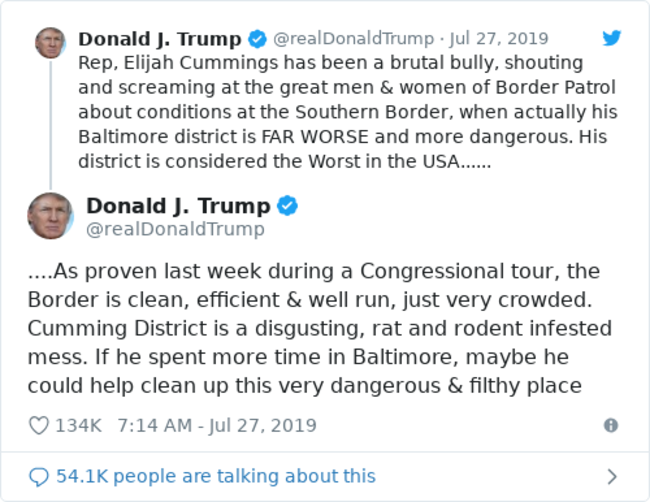 | | Why Trump did it: Well, it seems to be in Trump's nature to resort to stereotypes of gender or race when attacking his political opponents. But Trump also appears to have been encouraged to proceed this way. His advisers think he is giving voice to white, working-class Americans who fear immigrants are taking their jobs and are tired of being accused of being racist. It's a 2020 strategy to shore up the base, reports The Post's Toluse Olorunnipa and Ashley Parker. "Republicans, for as long as I can remember in politics, we've all been called racists just because of our policy ideas," said Kelly Sadler, a spokeswoman at America First Action, a pro-Trump super PAC, told The Post. Why Trump might regret doing it: Several polls have shown that about 60 percent of Americans think Trump went too far with his racist tweets against those four Democratic lawmakers. Not even Trump's supporters in Washington liked the way the president's fans chanted "Send her back" about a Somali American congresswoman days after his tweets telling her to go home. | 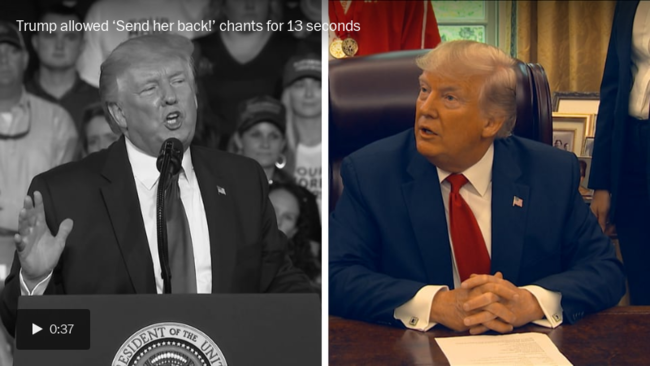 | | Trump allowed 'Send her back!' chants for 13 seconds | | And while Trump apparently thinks he can rally his base, he is ignoring the likely opposite reaction. Writes The Fix's Eugene Scott: "[T]hey may be disregarding the possibility that another form of cultural anxiety exists, as well: the fear among liberals of a United States where racism will go unchecked as never before." What's "The Squad" and why are we all talking about it? | | | A couple of weeks ago, I focused on who "The Squad" is in this newsletter. They have remained a big part of the conversation about Trump, race and politics, and their moniker has become more widely used, so let's look at what the term means. "The Squad" refers to the four Democratic congresswomen to whom Trump tweeted "go back" — they're all younger than the average member of Congress, and they're all women of color. Two are the first Muslim women elected to Congress. How it got started: Alexandria Ocasio-Cortez (N.Y.) posted a photo of the four of them — herself, Ilhan Omar of Minnesota, Ayanna Pressley of Massachusetts and Rashida Tlaib of Michigan — shortly after they were elected to Congress. The four are like-minded lawmakers who were hanging out. She captioned it "Squad." "Squad" is a term that's been appropriated from pop culture, which appropriated it from hip-hop, which, thanks to that photo and these women's high-profile presence, is now firmly entrenched in the 2020 political sphere, The Post's Elahe Izadi and Kayla Epstein report. They talked to scholars who say that depending who's talking and listening, "Squad" could signal a sisterhood, a political caucus of people championing issues important to people of color, a generational divide or resistance to Trump. On the flip side, Trump and his allies are trying to use the term to demonize all Democrats as too liberal. | 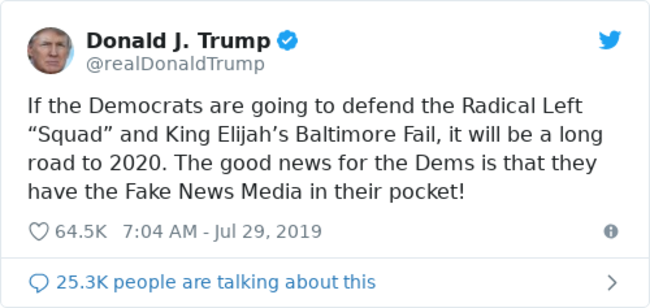 | | Both sides see political value in using it, which means that, like it or not, you're going to be hearing "the Squad" a lot, and it's open to interpretation. How to watch the second Democratic debates | Former vice president Joe Biden and Sen. Kamala Harris (D-Calif.) debate racial issues as Sen. Bernie Sanders (I-Vt.) listens during the first debates in June. | The second round of Democratic debates are this week, and they could prove a make-or-break moment for a number of presidential candidates. Here's what you need to know. And more on what I'll be watching for here. Date: Tuesday, July 30 and Wednesday, July 31 Time: 8 p.m. Eastern Where: The debates will be held in Michigan, a state Trump won by less than half a percentage point. CNN and Telemundo will broadcast it. But if you don't have cable, you can stream it on CNN.com or CNN's app. Why are there two nights? Because there are 20 candidates. Well, there are more than 20 candidates running for the Democratic nomination, but only 20 will be debating. So, like last time, 10 candidates will debate on the first night and 10 on the second. | | Who's on which stage? It's Sen. Kamala D. Harris (D-Calif.) vs. former vice president Joe Biden, redux. | (Shelly Tan) | I'll be sending out a special edition of The 5-Minute Fix after each debate. See you in your inbox in the wee hours of Tuesday night! | | | If you want to get The 5-Minute Fix in your inbox three afternoons a week, sign up here. And click here if you want to ask me a question about politics, send me a gif or give me a compliment. Still want more politics in your life? Read these awesome pieces:
| | | | | | | |









 Twitter
 Facebook


Komentar
Posting Komentar