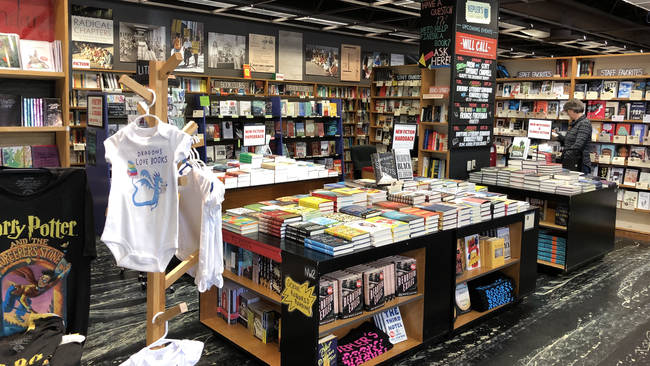
| Earlier this month, the cover of New York magazine blared: "An Entire Issue With Nothing About Trump!" I'm going to follow their lead for this issue: "An Entire Newsletter With Nothing About Trump!" Think of it as a welcome detox from His Tweetness, which is appropriate because I'm in San Francisco this week, where everybody is on some kind of detox diet. | Kepler's Books, Menlo Park, Calif. (Ron Charles/Washington Post) | I learned a lot about bookselling in the Bay Area. In 2012, Kepler's, a legendary but faltering bookstore in Menlo Park, invited me to a three-day meeting to re-imagine what a community bookstore could be. Eighty of us — publishers, authors, fundraisers, entrepreneurs, bookstore staff, philanthropists and customers — holed up in a conference room with lots of white paper and magic markers. The specter of Amazon hung over the discussions. The process was something between a course in bookselling and an EST meeting. Kepler's CEO Praveen Madan, presented an innovative plan to split the business into two parts: a for-profit bookstore and a nonprofit foundation dedicated to literary programs. It sounded like a liberal pipedream, but talking to Madan now, he says, transforming Kepler's into a social mission-driven organization has been "a resounding success." The store has been profitable for six consecutive years, and, true to its hippie roots, most of the profits are distributed back to the staff. Meanwhile, the non-profit Kepler's Literary Foundation produces over 200 events and classes a year that attract about 25,000 people. Madan says, "Our community continues to support Kepler's through annual memberships, tax-deductible donations, buying tickets for premier events — in addition to purchasing books." Many bookstore owners have sought out Madan's advice, but only a few have managed to replicate his complex model. Of course, Kepler's success depends in part on the store's golden location near Stanford University. But Madan's plan is really just a more radical application of the principle that every indie bookstore owner knows: Survival depends on community engagement. | 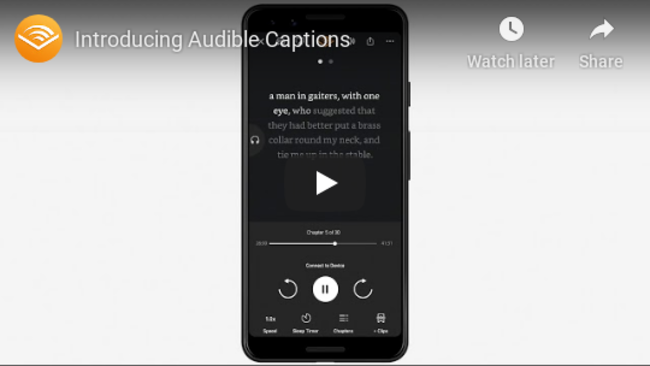 | | Audible wants you to "see storytelling in a whole new way," but publishers are seeing red. The Amazon-owned company, which dominates the audiobook industry, announced plans to offer a feature called Captions. A video released on YouTube shows a cellphone playing the audiobook of "David Copperfield." As Richard Armitage narrates, lines of the text run across the screen. Large and small publishers, along with the Authors Guild, have condemned this forthcoming feature. They argue that by offering listeners a spontaneous transcription, Audible is effectively selling an unauthorized ebook version. A spokesperson for Penguin Random House tells me, "We have reached out to Audible to express our strong copyright concerns with their recently announced Captions program, which is not authorized by our business terms. We have indicated that we expect them to exclude all Penguin Random House titles from the program and will take necessary steps to ensure our position." Publishers Weekly quoted a statement from Audible that said, "Given that the feature isn't live yet, we are in discussions with content providers to help address some confusion about how Audible Captions works and what listeners will experience." I suspect confusion is not the problem. This could escalate into the next battle royale between traditional publishers and Amazon. (Amazon CEO Jeff Bezos owns The Washington Post.) | 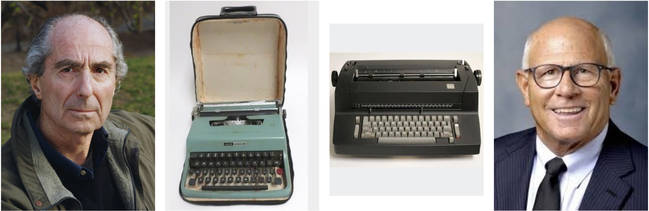 | Philip Roth (Nancy Crampton); Typewriters (Courtesy of Litchfield County Auctions); Steve Soboroff (Los Angeles Police Department) | At the auction of Philip Roth's personal property last Saturday in Litchfield, Conn. the late writer's three typewriters attracted enthusiastic interest. Two of them — an IBM Selectrics ($4,800) and an Olivetti manual ($17,500) — were bought by Steve Soboroff, an avid collector who is president of the Los Angeles Board of Police Commissioners. Soboroff's favorite Roth novel is "Portnoy's Complaint," but now that he owns two of Roth's typewriters, he hopes to read more of the late author's books. Speaking to me from Matha's Vineyard, he notes that the ribbon on the Selectrics preserves an imprint of each character, which will allow him to determine exactly what Roth wrote on that machine. But Soboroff is not a literary detective; he's a pop culture enthusiast. "I like to buy typewriters from people who have been on the covers of Time, Newsweek or Vanity Fair," he says with a laugh. His collection includes typewriters once owned by Greta Garbo, Orson Welles, Tennessee Williams, John Updike, Barbra Streisand, John Lennon, Joe DiMaggio and even Ted Kaczynski. Soboroff frequently lends them out to museums. More than a dozen of his machines are currently at the Writers Museum in Chicago, including Maya Angelou's and Ernest Hemingway's. If you make a sufficiently large donation to the Jim Murray Memorial Foundation for sports journalism, Soboroff will even let you type on one of them. "Typewriters are peaceful," Soboroff says. "They take us back to a simpler time." |  | | Star Trek fans are overheating like a warp core about to breach. A trailer for "Star Trek: Picard," the upcoming CBS series co-produced by novelist Michael Chabon, was unveiled at Comic-Con in San Diego. As even Romulans know, Gene Roddenberry's original series only lasted three years, but since it ended in 1969, spinoffs have multiplied like Tribbles. But aside from the TV shows, movies and web series, there's also a parallel galaxy of Star Trek books: fanfic, novels, short story anthologies, critical histories, memoirs, biographies and novelizations, which, I confess, I used to crave like an Ornaran craves felicium. For fans who can't get enough, Jacobs/Brown Media Group has released an audiobook version of "These Are the Voyages" (2013), Marc Cushman's exhaustive history of the first season of the original series (sample). The recording uses an extraordinarily large cast of nearly 100 narrators, including Vic Mignogna, who plays Captain Kirk in the web series "Star Trek Continues"; Adam Nimoy, Leonard Nimoy's son; and Rod Roddenberry, Gene Roddenberry's son. This summer, if you plan to boldly go where no one has gone before, this could be just the audiobook you need. | 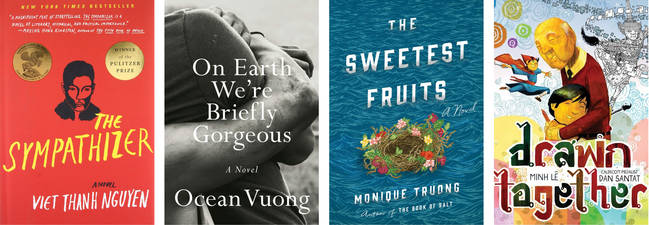 | (Grove; Penguin Press; Viking; Disney-Hyperion) | | One of the happiest recent trends in U.S. publishing has been the renewed prominence of books by Asian Americans. From Viet Thanh Nguyen's Pulitzer Prize-winning novel, "The Sympathizer," to Kevin Kwan's bestselling "Crazy Rich Asians" series, Asian Americans have been finding enthusiastic audiences across all genres. That tremendous success and the complex challenges that persist will provide lots to explore at the Asian American Literature Festival in Washington next weekend (Aug. 2-4). Presented by the Smithsonian Asian Pacific American Center, the Library of Congress and the Poetry Foundation, the festival includes more than 80 authors — including Monique Truong, Ocean Vuong and Minh Lê — who will deliver readings and lead discussions. Many of the events extend beyond the usual lit-fest fare. The first day opens with a "Poets' Peace Breakfast" in Franklin Square Park. The second day ends with "Queer Literaoke," when authors read from their work and sing a verse from their favorite song (full schedule). Lawrence-Minh Davis, director of the festival, is a brilliant and earnest advocate for literature written by people who have a history of resettlement and assimilation. The "Asian-American lens" is crucially important, he explains, when "we are perpetually grappling with immigration and nativism and nationalism and what it means to belong and who belongs and who gets to claim belonging and how we welcome people or don't welcome people." Needless to say, everyone is welcome to this festival. | 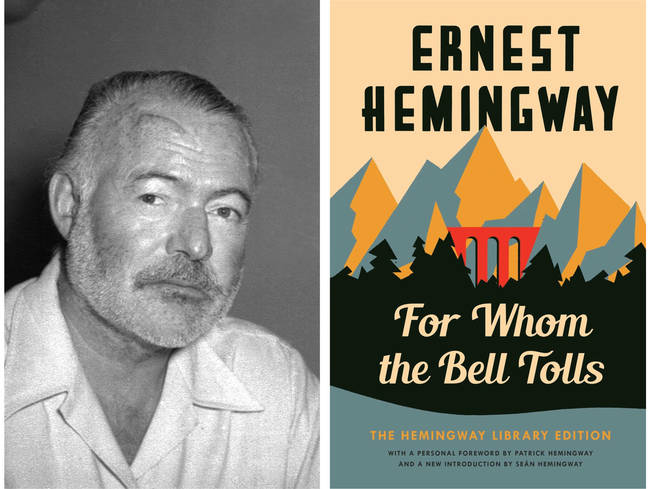 | Ernest Hemingway in Cuba, 1950 (AP Photo; Scribner's) | I first read "For Whom the Bell Tolls" long before I had sex, but even then, Hemingway's love scenes struck me as wildly unrealistic. Not to mention the novel's archaic grammar (all that "thou" and "thee" translated from the Spanish), and the characters' censored swearing, which is kind of witty at first but then starts to seem like a [obscenity] joke. But even I felt the earth move when reading the beautifully designed new edition of "For Whom the Bell Tolls" released this month by Scribner's, which has been publishing Papa since 1926. The appendix includes notes and excerpts from early drafts of the novel, and three later Hemingway stories, two of which have never been published. In a brief, poignant foreword, Patrick Hemingway (Ernest and Pauline Pfeiffer's son) writes, "I have always associated For Whom the Bell Tolls with the end of my parent's marriage." A longer introduction by Seán (Hemingway's grandson) provides helpful biographical and critical context. I'm not convinced, as Seán concludes, that it is "perhaps his finest novel" — that would be "The Sun Also Rises" — but I'm willing to admit that I've been [obscenity] wrong about this book for a long time. | 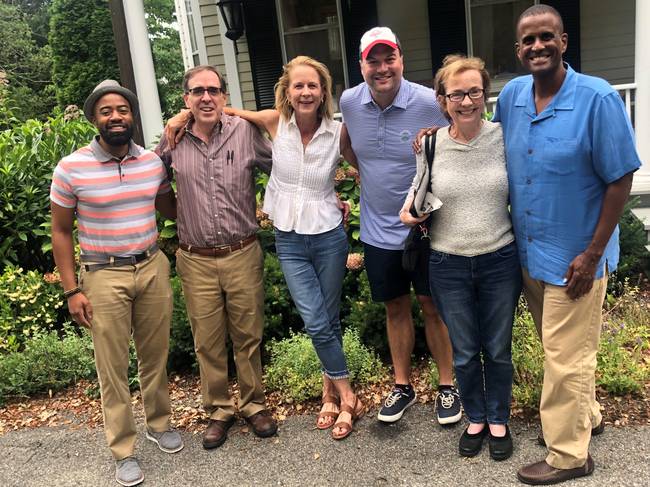 | Sound engineer Marcellus Suydam alongside podcast participants Ron Charles, Torie Clarke, Michael Kornheiser, Jeanne McManus and David Aldridge in Chevy Chase, Md. (Chatter on Books) | Chatter-on-Books started in Tony Kornheiser's Northwest D.C. restaurant, which may account for the sportstalk vibe of this new podcast. Created by Torie Clarke, who once worked for Defense Secretary Donald Rumsfeld, the weekly show offers snappy literary quizzes, quick-takes on the bestsellers and smart interviews with authors. Somebody must have canceled at the last minute because this week they had me on. Seated at a large table with Clarke; former Washington Post sports editor Jeanne McManus; the editor-in-chief of the Athletic, David Aldridge; and Kornheiser's son Michael, I started having bad flashbacks to 8th grade gym, but they couldn't have been nicer — or more fun. (Listen here.) | Michael Lindgren | We lost one of our favorite book reviewers this week — but for the best possible reason. Freelance writer Michael Lindgren has been named managing editor of Melville House Books, the independent publisher in Brooklyn. Lindgren started writing for Book World in 2008 and quickly became one of our go-to reviewers for books on music, the arts and criticism. Melville co-founder Dennis Johnson tells me, "Having worked at the legendary indie publisher Zoland Books, and at an equally legendary bookstore (Colosseum Books!), and even been a noted book critic, Mike has an incredibly wide-ranging experience in how to put out necessary books in a cacophonous marketplace. It's like we got a new, secret weapon, and as soon as the publicity department is speaking to me again (apparently he often wrote very good reviews of our books in some big newspaper), I plan to broadcast this more widely." | | Let's keep in touch. If you have any questions or comments about this weekly newsletter or The Post's book coverage, contact me at ron.charles@washpost.com. If you know someone who would enjoy this newsletter, please forward it to them. To subscribe, click here. | | | | | |








 Twitter
 Facebook


Komentar
Posting Komentar