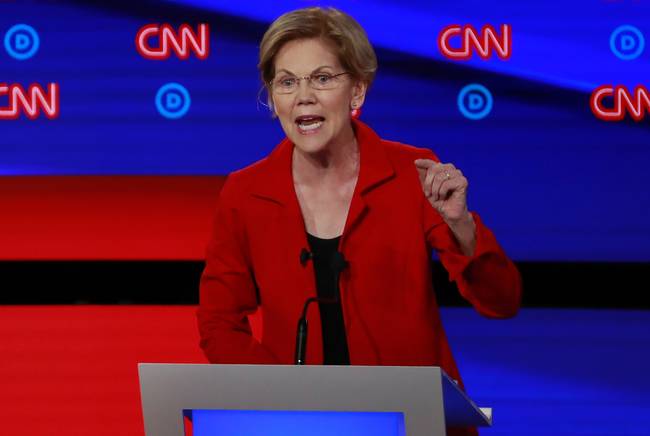
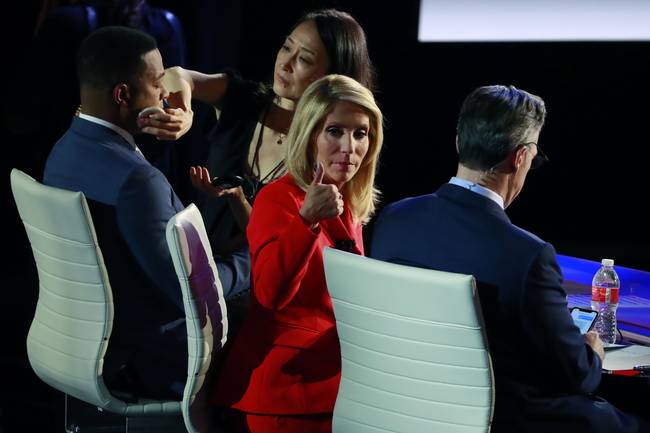
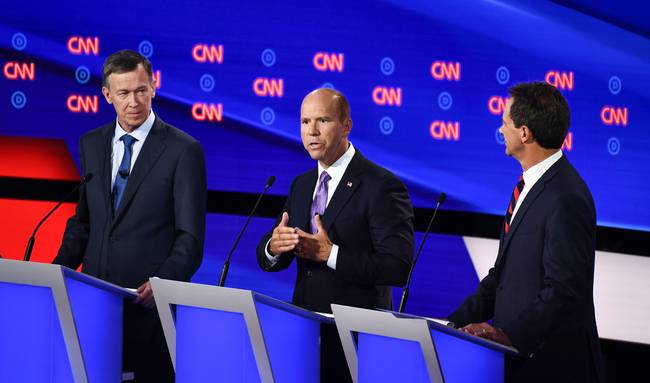
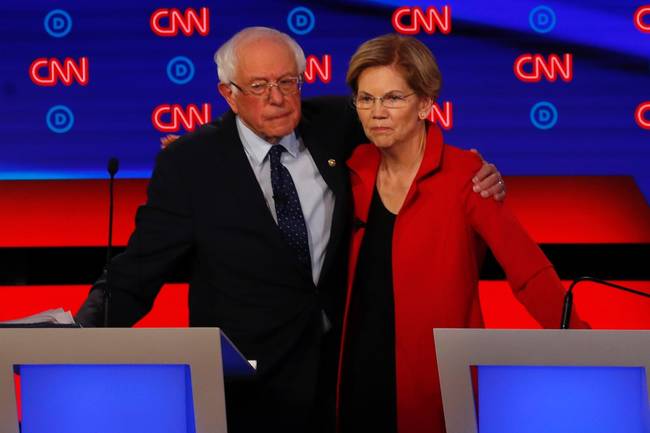
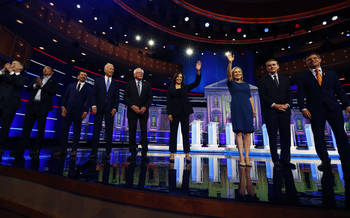
| Warren (REUTERS/Lucas Jackson) | Elizabeth Warren: Neither of the two leading candidates in Tuesday's version of this week's debate — Sen. Elizabeth Warren (D-Mass.) and Sen. Bernie Sanders (I-Vt.) — ran into too many problems. But on balance, Warren seemed to be better at enunciating her liberal policy proposals and parrying attacks from those challenging her. She is also more ascendant in the polls than Sanders, which means a more-or-less status-quo debate suits her. "Republican talking points": Warren on two occasions hit back at criticisms by moderates of her health care and other policies as a "Republican talking point." At another point, Sanders attacked the line of questioning from CNN's Jake Tapper. "And Jake, your question is a Republican talking point," he said. Both were responding to repeated questioning of their liberal policies. What's clear is that if either of them is the Democratic nominee, Republicans did get some talking points out of Tuesday's debate. | | CNN's moderators: Sanders's complaint was misplaced. CNN's moderators — Tapper, Dana Bash and Don Lemon — challenged the candidates by accurately summarizing the arguments against their policies. They did it on single-payer health care, on decriminalizing illegal border crossings, and free college tuition and on several other topics. There were also lots of substantive back-and-forths, without the constant interruptions that marred the second night of the first Democratic debate. When candidates tried to jump in to get more time, they kept it moving and didn't let themselves be bullied. | Moderators Don Lemon, Dana Bash and Jake Tapper of CNN. (REUTERS/Lucas Jackson) | There was a drawback though, which we'll get to. John Delaney: The former Maryland congressman has been a bit player in the 2020 race, and that was definitely the case in the first debate. At the start of Tuesday's debate, though, Sanders was asked about Delaney's criticisms of his health-care proposal. They went back and forth before anyone else got a chance to weigh in. At another point, Delaney earned a rebuke from Warren, too, with the Massachusetts senator decrying Democrats like Delaney who are running "just to talk about what we can't do and shouldn't fight for." It was a big applause line. But Delaney got a chance to make his case, over and over, serving as the main foil for Sanders and especially Warren. That's about the best he could have hoped for. Whether liberal primary voters are buying what he's selling? That's another issue. | | | Former governor of Colorado John Hickenlooper (left) and Montana Gov. Steve Bullock (right) listen to former congressman John Delaney. (BRENDAN SMIALOWSKI/AFP/Getty Images) | Pete Buttigieg: For the second straight debate, the South Bend, Ind., mayor may not have been a standout, but he again showed himself to be a skilled debater, navigating the divide between the more moderate candidates on the outside and the liberals in the middle. He's shown a deft touch at appealing to both wings of the party. He hasn't built much after an early plateau, but thanks to steady debating and strong fundraising, he'll continue to be a player. Marianne Williamson: Williamson was widely savaged for her at times bizarre performance in the first debate. But on Tuesday night, she had some of the biggest applause lines of the entire debate, including perhaps the biggest one, on reparations. When asked about the water crisis in Flint, Mich. — just down the road from Detroit — she said, "What happened in Flint would not have happened in Grosse Pointe." (Williamson has lived in Grosse Pointe, Mich., which is far less diverse than Flint.) | Sanders and Warren. (AP Photo/Paul Sancya) | The big Sanders vs. Warren clash: Or not. One of the drawbacks of the crowded Democratic field is that the debates split up the leading candidates. Given Sanders and Warren were not in the same debate last month and that Warren has risen in the polls while Sanders has fallen — while appealing to similar voters — everyone was girding for them to actually, you know, debate one another. Instead, they largely agreed to a cease-fire. At one point when Sanders was being attacked, Warren tried to cut in to (apparently) defend him. Another time, Sanders attempted to return the favor. Warren was asked if her statement that she was a capitalist was meant to contrast herself with Sanders, the democratic socialist, and she demurred. At another point, Sanders said of Warren, "Elizabeth is exactly right." They may have to joust eventually, but it wasn't happening Tuesday night. The format: What CNN's moderators gave, the format took away. CNN spent about 20 minutes at the start on candidate introductions, a commercial break and then (canned) opening statements. And then they held to a very rigid time limit on rebuttals, often cutting substantive responses short. The first debate, put on by MSNBC, was better about getting right to it. Maybe spend less time on the build-up and allow a little more response time. | 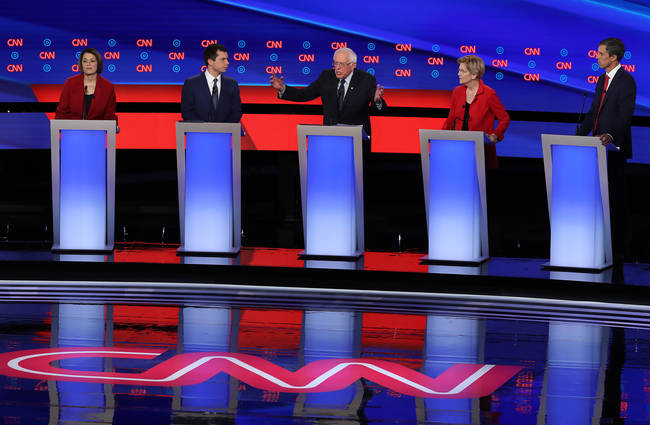 | Candidates debate at the Fox theater in Detroit. (Justin Sullivan/Getty Images) | Medicare-for-all: Single-payer health care has been on the march in the Democratic Party. But on Tuesday night, it got some pushback — a lot of pushback — from Democratic presidential candidates. The first 25 minutes of the debate was devoted to the topic, and the also-rans of the Democratic primary used it to argue that the likes of Sanders and Warren were promoting pie in the sky. In fact, those two were generally outnumbered. Delaney said moving Americans from private to government insurance would be telling them "their health care is illegal." Montana Gov. Steve Bullock called it "wish-list economics" and said Democrats were promoting the type of "repeal and replace" Republicans used to. Former congressman Beto O'Rourke said it would be "taking away people's choice." Rep. Tim Ryan (D-Ohio) said the plan would tell union members who have negotiated their private insurance they "will lose their health care because Washington is going to come in and has a better plan." Sanders and Warren pushed back and got applause. If the crowd mirrors electorate, they will be just fine — but it won't exactly. The question is whether this presages a reexamination of this issue or whether this was just a fluke thanks to some of the most moderate candidates being put on a stage with Sanders and Warren. Beto O'Rourke: Anonymous in the first debate. Lackluster second quarter of fundraising. Falling poll numbers. Anonymous at the second debate. The magic hasn't re-materialized for him. Steve Bullock: The Montana governor was the new entry in the debates, after getting a late start on qualifying for the first one. And he cued up a contrast with Sanders, saying in his opening statement that struggling Americans "can't wait for a revolution." But he didn't really deliver on that angle and often stumbled over his words. Delaney wound up being the foil for Sanders and Warren that he aspired to be. | | | If you want to get The 5-Minute Fix in your inbox three afternoons a week, sign up here. And click here if you want to ask me a question about politics, send me a gif or give me a compliment. Still want more politics in your life? Read these awesome pieces:
| | | | Recommended for you | | Get The Trailer newsletter | | News and insight on political campaigns around the country, from David Weigel. 435 districts. 50 states. Tuesday, Thursday and Sunday evenings. | | | | | | | | | |








 Twitter
 Facebook


Komentar
Posting Komentar